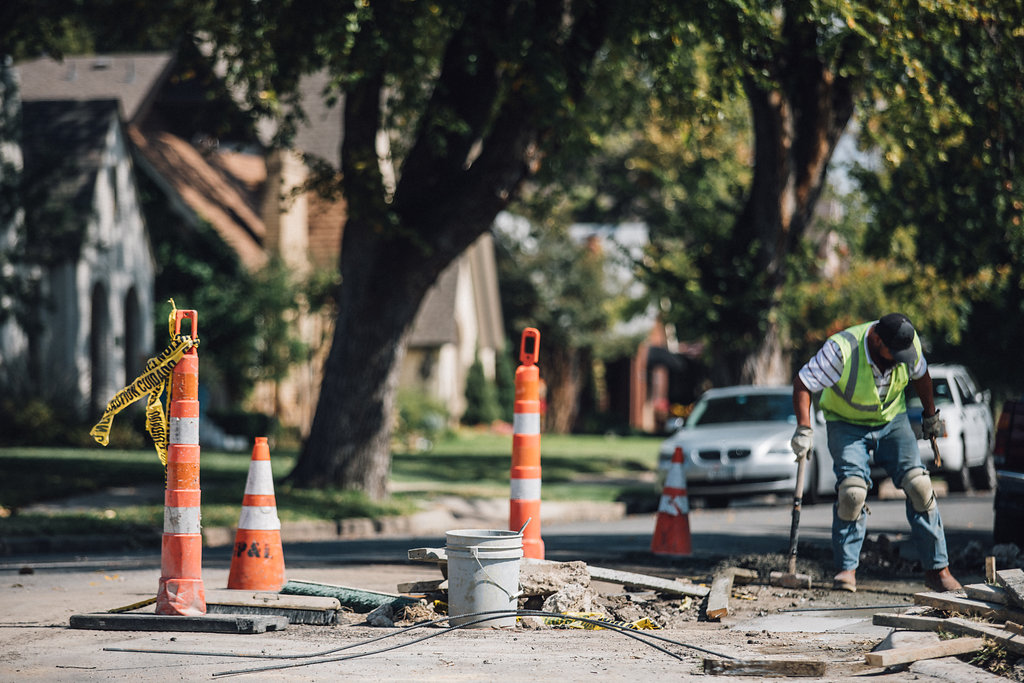
Earlier this month, I mused on the unsightly, maladjusted pavers in the sidewalk in front of the Meyerson. A formerly elected FrontBurnervian passes along this photo that shows the problem is now being remedied.
The windows at the downtown Neiman Marcus have been covered with a tarp for a while, as their holiday displays were being built. The unveiling will happen Friday. The release, after the jump, says: “This year’s hint…be sure and bring the kids for an unparalleled energetic journey through fantasy and fun!” So you’ve been warned. Afterward, there will be singing and so forth at Main Street Garden. I’d be surprised if the missus, a noted fan of caroling and all things Christmas, doesn’t already have this one on our calendar. (They serve liquor at the Main Street Garden, right?)
The AT&T Performing Arts Center is up and running. The Main Street Garden park opens today. Woodall Rodgers Park will be ready in a couple of years. We might be getting streetcars at some point in the near-ish future, and possibly bike lanes, too. (Maybe.) All good things. But, of course, downtown could use more good things, whether they’re practical (a dry cleaner — Tim’s idea) or just something that would be nice to have (a bookstore — my idea). What say you? Feel free to get whimsical. It’s Friday, after all. And, what’s more, there are no bad ideas in a jam session.
(UPDATE: I should point out that Joan Arbery and Renegade Bus were on this train a few weeks ago. I think we linked to it previously, but in case you didn’t see it before, or haven’t waded into the comments yet, here you go.)
Stephen Hough writes for London’s Telegraph. He’s kind of a big deal. He’s visiting our fair burg to hear the DSO. An alert FBvian points us to the following dispatch. Here’s what Hough has to say about Dallas so far:
There are many wonderful things about this city, not least the DSO and their acoustically miraculous home, the Morton H. Meyerson Symphony Center, but downtown shopping is not one of the highlights of a visit here. I walked for several blocks with only the ghosts of former stores in evidence until, finally … there was something to buy across the street.
Check out what he found to buy.
Correction: Yes, Hough will hear the DSO. But he’ll also perform with the orchestra. Says Stacie Adams, PR maven for the symphony:
We won the Grammophone award for our recording with Stephen in 2005. He is amazing. And he is performing the same piece, my all time fave, Rhapsody on a Theme of Paganini by Rachmaninoff, tonight and through the weekend.
On the first full week of every month, I get the pleasure of broadcasting with Adriana Bate on WRR for about a half hour from One Arts. Now that we’ve moved our offices downtown, that means I get to walk down Flora Street for our 11 o’clock date every day. My trip takes me past the Nasher, the Meyerson, the Winspear, and the Wyly. It’s lovely, especially when the weather is as nice as it is today. But I’ve been studying something on my walk that has caught my eye before: the cobblestones (or bricks, really) that pave the sidewalk. In front of the Meyerson, they are a wreck. Some are missing. Many have become dislodged. We don’t get much practice here in the United States, but over in Europe, where they’ve been at it a bit longer, they know that cobblestones make perfect projectiles to throw in times of revolution. All I’m saying is, if the workers rise up and clash with the police down in the Arts District, the police are in for a tough fight.


Tomorrow from 6 to 7 p.m., Troy Aikman will be hanging out on the Katy Trail to kick off the Friends of the Katy Trail’s first-ever membership drive. Laura, that sounds like your beat, runner woman.
Krista, I hate piling on a person or an agency when they’re down, but I’ve got another big bone to pick with DART. Here it is: Like a good little fledgling urbanite, I vowed to make a habit of taking the light rail from home to our new downtown offices–and did so last week. The upshot? The very first day I parked the family vehicle at the White Rock transit station–less than a mile from our house in Merriman Park–criminals ripped away at the passenger-door lock, ransacked the car and made off with a bunch of stuff, including the entire center-console bin. This, after I’d parked outside our house in our driveway every night for the last 9-plus years–and never had the car touched once. Now, I’m aware this sign looms over the White Rock park and ride facility: “Not Responsible for Theft or Damage to Vehicles.” But I’m sorry; that ain’t good enough. Why shouldn’t DART have to secure its parking facilities for its paying customers? Until it does, I’m staying off their trains and out of their lots.
One Arts Plaza has that big white square on the side, and the Hunt Oil Tower bulges out like a, well, like a giant H. So I guess it makes sense that downtown’s new Dee and Charles Wyly Theatre has a big rectangular hole at the top on its west side (at far left in this pic). At first I thought they just hadn’t finished the building yet. But I’ve learned since that it’s actually an important architectural feature. On the big media tour this morning, I asked the architect Rem Koolhaas–a tall, gaunt Dutchman who kept checking his cellphone–about the thinking behind the big hole. “You have to have some things where your interest can dwell for awhile,” he explained. Then he went back to checking his phone.
SweetCharity and I picked up Helen Anders of the Austin American-Statesman (formerly Helen Bryant of the DMN) early this morning for the dedication ceremony of Dallas’ $354 million AT&T Performing Arts Center. (Helen’s staying with her daughter in Arlington.) Local movers and shakers like Tom Leppert, Jim Oberwetter, Bill Lively, Michael Hinojosa and Jan Strimple turned out in force for the outdoor event, which took place in chilly, foggy weather more reminiscent of San Francisco than Dallas. When the speakers mentioned the grandeur of the center’s “public park” during the ceremony, Anders kept whispering, “What park?!”–a theme she continued in her interesting blog post about the event. SweetCharity weighed in with a report on all the hoopla as well.
It’s on at the Convention Center, and you can find relevant details at Michael Davis’ Dallas Progress blog. According to Mike, they’ll be discussing:
…linking The Dallas Farmers Market, the Arts District, the Cedars, Deep Ellum, and The Main Street District as well as future developments.
New offices downtown, first lunchtime in the new digs. The DMA/Seventeen Seventeen was closed and Dickey’s is too familiar, so we stumbled into Harwood 609 at … 609 Harwood St. It’s big–looks like it could seat 500–with an over-the-top Tiki theme and glittering disco balls. Not surprising, since the joint (pictured) turns into an old-school R&B club nights and weekends. (The Temptations played there, and they’re shooting to land The Blue Notes–minus Harold Melvin–for New Year’s). Our friendly waiter Quincy explained how the $5 lunch special included soup and salad, an entree and two sides, a drink and dessert. The lovely and talented Kristiana and I opted for well-done burgers with fries, while Jason tried the Southwest chicken sandwich. Total tab: $16.24–and the grub wasn’t half bad. Still, I think there’s a male/female split on a return trip. Kristiana said Harwood 609 looked like an off-strip Vegas lounge and won’t be going back for lunch. Jason and I liked it. I mean, where else can you hear “Cowboys to Girls” (The Intruders) on the sound system at noon? Back to you, Nancy.
In the current episode of the “print product,” there appear two stories about an experiment we ran to determine whether the forthcoming Museum Tower might possibly interfere with the Nasher Sculpture Center’s wonderful installation Tending, (Blue). You can read Willard Spiegelman’s sober, insightful account of our caper here. Me, I just write jokes. Anyway, I’d forgotten till now that I’d taken this picture. In the final scene of my story, when the DSO’s PR director, Stacie Adams, catches me standing in their backyard, here’s what I was doing:
This Friday evening, the Trinity Trust Foundation is throwing what it’s calling a “bridge fair” on the Continental Bridge to celebrate the progress being made on the Marget Hunt Hill Bridge (full release after the jump). Santiago Calatrava will be in attendance. The band Boys Named Sue will play, and the foundation promises other “delectable delights.” Tickets cost $150, a price point established, I believe, to keep Jim Schutze from attending. D Magazine is a media sponsor, so I’ll be there. Look for me wherever the delectable delights are located.
Frank Bliss is executive vice president of Cooper & Stebbins, which developed the phenomenally successful Southlake Town Square. Even as large as that project already is — the size of downtown Fort Worth in terms of acreage — Bliss said they’re still only about 35% finished with their vision. In particular, they have more office and residential offerings in mind.
When I asked his thoughts about Downtown Dallas, he was quick to answer: “Downtown Dallas has no soul … Dallas never planned for a soul.”
To reclaim its soul it needs a true center. As do many others, he cites the construction of the tunnels years ago as one major mistake, sucking away the street life. (more…)
There’s a thoughtful post today on FortWorthology about the greatest loss to Fort Worth’s history. Their answer is the decimation of Hell’s Half Acre, downtown’s “red light” district until the 1960s.
It’s worth a look for the amazing contrast of two photos of the south end of downtown Fort Worth — one from 1956, the other from Google Earth (a few years ago). You’ll see an unfortunate transformation:
The biggest change you’d see now is the completed Omni Hotel, which is just under construction in this image. This shows the amount of change and destruction brought to the south end: block after block after block of urban, humanly-scaled buildings, replaced by massive superblocks (such as the Convention Center) that impede walkability, overscaled architecture, and seas of storage for cars. The loss of density and walkable fabric is incredible.
You’ll remember that Wick argued for human scale in downtown Dallas.
Over on Renegade Bus, Peter Simek compares the Woodall Rodgers Park with Millennium Park in Chicago (a comparison the Woodall boosters themselves have made) and asks some good questions. Worth a read.
The Talking Heads musician turns out to be a student of cities. In the Wall St. Journal Friday, he put together the aspects of city life that he finds beguiling. He also takes a few shots:
In Dallas livability might mean that you live near an expressway that isn’t jammed up, at least not all the time, and your car runs most days. For some it might mean super fast Wi-Fi, the possibility of lucky and lucrative business opportunities and plenty of strip clubs. If that’s what rocks your boat then try Houston, though to me that city, oil money made physically manifest, is my worst nightmare.
Saying something disparaging about Dallas is merely a sign that one doesn’t know it well. Saying something disparaging about Houston is a sign of a discriminating intelligence.
Let me give you a hint on how to live a peaceful life. It’s simple. Never write an editorial dissing engineers. I don’t want to suggest engineers are senstive, but if you ever have the misfortune of stepping on one’s toes, be ready to call an ambulance.
Luckily, Geoffrey Orsak, dean of SMU’s Lyle School of Engineering, doesn’t seem so easily perturbed, probably because as an academic he’s developed some tough skin and sharp elbows of his own. In the forthcoming issue of Design News, he continues the debate we started on KERA’s Think a couple of weeks ago about engineering and the city.
Joel Kotkin is one of my favorite urbanists, and here he does a take-down on the usual “best cities” lists such as those recently published by The Economist [sub. req], Monocle, and Mercer. He notes a problem with the criteria: in each, the survey tilts heavily toward compact places in prosperous areas with good mass transit, cultural institutions, with few children and fewer poor people. In other words, the criteria tilt toward the sort of quiet, beautiful places in which the editors would like to retire. He then offers a contrary view:
It seems to me what makes for great cities in history are not measurements of safety, sanitation or homogeneity but economic growth, cultural diversity and social dynamism. A great city, as Rene Descartes wrote of 17th century Amsterdam, should be “an inventory of the possible,” a place of imagination that attracts ambitious migrants, families and entrepreneurs. Such places are aspirational – they draw people not for a restful visit or elegant repast but to achieve some sort of upward mobility.
He then goes on to give as examples Los Angeles, Shanghai, Mumbai, and… Houston.
Joel, we’ve got to talk.
Kudos to Jose Escobedo, the guy with the artificial-turf lawn in Junius Heights. After the Landmark Commission ordered him to rip the lawn up, Escobedo’s vowing to take his lonely AstroTurf crusade to the City Plan Commission and the Dallas City Council, if necessary. I especially liked the anti-Escobedo commenter on an earlier Unfair Park post who said: “This is a historic district, so if you want something fake, move to Frisco.” (A Grade A example of holier-than-thou, phony aesthetic elitism.) Seems to me if you really wanted to save on water, everybody would put in one of these fake lawns.
Things I learned from this City Hall Blog post:
• Atlanta’s Archer Western won the $44.5 million contract to build the Woodall Rodgers Deck Park.
• Henceforth, and until someone steps up with sponsorship money, it will unofficially be known simply as “the Park.”
Things I didn’t:
• When I should expect to be able take a picnic basket to said “Park,” even though I probably never will actually do that, and am really referring to a stereotypical park activity that will theoretically be undertaken by someone who is not me. (Actually, I’m kidding. That is exactly what I plan to do. Along with Frisbee® and/or Frisbee® golf.)
This morning, Scott Cantrell in the News cast a critical eye at the already-dated- looking new convention hotel. Scott’s critcisms are mostly architectural, and I don’t think there are many professionals who would disagree with the point he makes.
But his point is not big enough. Yes, the facade of this building may be a problem, but the setting is a disaster.
Here we go again, plunking down big, multi-story buildings without giving the slightest thought to how humans interact, without regard to human scale, and without any concern for visual pleasure. Our own City Hall is our most famous example, a large, tilting pile sitting alone in its plaza, as isolated as a leper at an orgy. The Convention Center is even worse, a gigantic curse of concrete strung along for whole city blocks.
Imagine standing outside this planned hotel on those wide swaths of concrete in July (hello, Mary Kay conventioneers! Are the glass and concrete making you hotter than you already were?). The deserted feel, if not the architecture, would be eerily similar to Victory Park on a Sunday afternoon.
Developer Matthews Southwest says it intends to fill in all the now-empty space with mixed-use buildings over time. Good luck with that. It seems Victory has taught them and the city’s planners nothing. So let me try to make this plain as day. There is no time. Make a site unfriendly to humans, and no humans will come. If you have to start big, as a convention hotel necessarily has to do, make sure the smaller, more intimate, more human-friendly buildings are there at the start to give your hotel some cover and context. Otherwise, we’re going to end up with another beached Dallas behemoth.
A FrontBurnervian responds:
Why not sell naming rights to Dallas parks? Because that is how we end up with Superpages.com Center, whatever the hell THAT is. Viagra Dealey Plaza? Red Bull Audubon Nature Center? Smirnoff Music Hall? Oh, wait, I think we already tried that last one.
Why do we name parks after dead people? Dead people by definition do not have money. Instead, we should name parks after live corporations that do have money. At least, that’s Rodger Jones’ idea over at the Dallas Morning News, and in a time of near-permanent cutbacks in government budgets it sounds like a good idea to me.
In a review of architecture critic Deyan Sudjic’s new book, The Language of Things: Understanding The World Of Desirable Objects, John King of the San Francisco Chronicle applies Sudjic’s thesis about the timelessness of good design to the question of why in a time of electronic communication and ecommerce, cities continue to attract.